

You have probably met someone who stays calm when everything falls apart. They listen well, say the right thing at the right time, and make others feel understood. That person likely has strong emotional intelligence.
So, what is emotional intelligence, exactly? And why do employers, therapists, teachers, and parents keep talking about it?
This guide answers both questions in plain language. You will learn the definition, the main models, the core skills, and how emotional intelligence shows up at work and at home. You will also get practical steps to build it and a list of mistakes to avoid.
What Is Emotional Intelligence? A Clear Definition
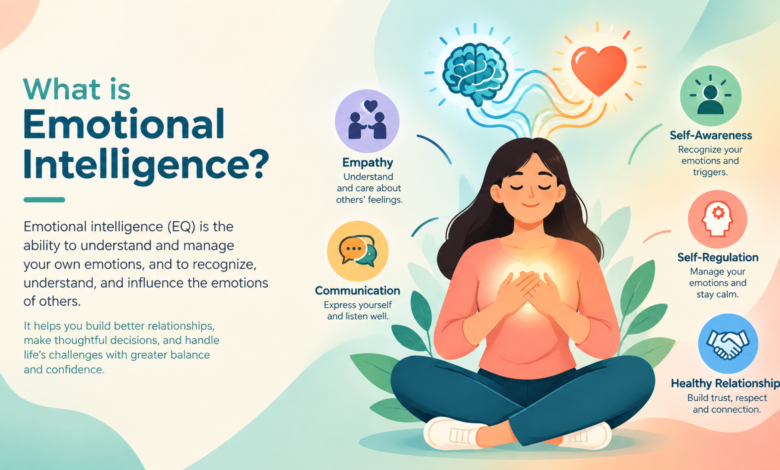
Emotional intelligence is the ability to notice, understand, and manage emotions. That includes your own feelings and the feelings of other people. It also means using that awareness to think clearly, make decisions, and build healthy relationships.
Many people shorten it to EQ, or “emotional quotient.” The term mirrors IQ, which measures reasoning and problem-solving. IQ tells you how well someone handles logic. EQ describes how well someone handles feelings.
Here is a simple way to picture it. Emotions are information. Anger might signal that a boundary was crossed. Anxiety might point to a risk you have not looked at yet. Emotional intelligence is the skill of reading that information and responding wisely instead of reacting blindly.
What emotional intelligence is not
The idea gets misused often. A few clarifications help.
- It is not the same as being nice. Emotionally intelligent people can be firm, direct, and honest.
- It is not about suppressing feelings. It is about understanding them.
- It is not a personality type. Introverts and extroverts can both have high EQ.
- It is not fixed. You can build it at any age.
Where the Concept Came From
The term has a real research history. In 1990, psychologists Peter Salovey and John Mayer published a paper that described emotional intelligence as a form of social intelligence. They defined it as the ability to monitor your own and others’ feelings, tell them apart, and use that information to guide thinking and action.
Journalist and psychologist Daniel Goleman brought the idea to a wide audience. His 1995 book Emotional Intelligence became a bestseller. It argued that emotional skills matter as much as raw intelligence for success in life and work.
Since then, researchers have debated how to define and measure it. That debate is healthy. It also explains why you will see several different models, which we cover next.
The Main Models of Emotional Intelligence
Not every expert agrees on a single definition. Three models appear most often in research and training.
The ability model (Salovey and Mayer)
This model treats emotional intelligence as a set of mental abilities. It describes four branches:
- Perceiving emotions in faces, voices, and situations
- Using emotions to support thinking
- Understanding how emotions change and combine
- Managing emotions in yourself and others
Researchers who favor this model measure EQ through performance tests, much like an IQ test.
The mixed model (Goleman)
Goleman’s framework blends abilities with personality traits and habits. It is the version most people meet in books and workplace training. We break it down in the next section.
The trait model (Bar-On and others)
This approach treats emotional intelligence as a cluster of self-perceived traits, such as optimism, stress tolerance, and flexibility. People usually measure it with self-report questionnaires.
Each model has strengths. The ability model is rigorous. The mixed model is practical. The trait model is easy to apply. For everyday growth, the Goleman-style skill list works well, so that is what we use below.
The Five Core Skills of Emotional Intelligence
Goleman’s framework groups emotional intelligence into five components. Think of them as skills you can practice, not labels you either have or lack.
1. Self-awareness
Self-awareness means knowing what you feel and why. It also means understanding your strengths, limits, and triggers.
A self-aware person might say, “I am snapping at my team because I am worried about the deadline.” That one sentence changes everything. Once you name the feeling, you can deal with the real cause.
2. Self-regulation
Self-regulation is the ability to manage impulses and stay steady under pressure. It does not mean hiding emotions. It means choosing your response.
Picture an email that makes you furious. A person with strong self-regulation drafts a reply, waits an hour, and rewrites it. That pause protects relationships and reputations.
3. Motivation
In this model, motivation refers to inner drive. People with high EQ pursue goals for reasons beyond money or status. They stay optimistic after setbacks and keep going when progress feels slow.
4. Empathy
Empathy is the ability to understand what another person feels. It comes in two main forms. Cognitive empathy means grasping someone’s perspective. Emotional empathy means feeling something of what they feel.
Strong empathy does not require agreement. You can understand why a colleague is frustrated and still disagree with their plan.
5. Social skills
Social skills turn awareness into action. They include clear communication, conflict resolution, active listening, teamwork, and influence. Someone with strong social skills can deliver bad news with care and negotiate without burning bridges.
Why Emotional Intelligence Matters in 2026
Work and daily life keep changing fast. Artificial intelligence now handles many routine tasks, from drafting emails to summarizing data. As that happens, the skills that machines cannot copy well become more valuable. Empathy, judgment, trust-building, and thoughtful communication sit at the top of that list.
The World Economic Forum’s Future of Jobs Report 2025 supports this direction. It names resilience, flexibility, and leadership and social influence among the skills employers expect to grow in importance. Those skills overlap heavily with emotional intelligence.
Other trends push in the same direction:
- Hybrid and remote teams. When you communicate through screens, tone is easy to misread. Emotional awareness helps teams avoid unnecessary conflict.
- Mental health awareness. Burnout, stress, and loneliness are part of public conversation now. Emotional skills give people tools to cope.
- Human-centered leadership. Managers are expected to coach, not just command.
- Schools prioritizing social-emotional learning. Frameworks such as the one from CASEL (the Collaborative for Academic, Social, and Emotional Learning) guide many classrooms worldwide.
In short, emotional intelligence is no longer a “soft extra.” It is a core life skill.
Emotional Intelligence vs. IQ: Which Matters More?
This question comes up constantly, and the honest answer is that they do different jobs.
IQ relates to reasoning, memory, and problem-solving. Research links it to academic performance and certain job tasks. Emotional intelligence relates to how you handle people and pressure.
Some popular articles claim EQ matters “twice as much” as IQ. Be careful with claims like that. Researchers still debate how strongly EQ predicts success, and results vary by job and by how EQ is measured. A more accurate view is that both matter, and EQ becomes especially useful in roles that involve teamwork, leadership, and service.
A brilliant engineer with poor communication may struggle to lead. A kind communicator without technical skill may struggle to deliver. The best results come from combining both.
Emotional Intelligence at Work
Workplaces are where most adults practice EQ every day. Here is how it shows up.
Leadership
Leaders with strong emotional intelligence read the room. They notice when morale drops. They give feedback in a way that motivates instead of crushing. They also admit mistakes, which builds trust.
Teamwork
Teams with high collective EQ handle disagreement better. Members feel safe sharing ideas, raising concerns, and asking for help. Psychologist Amy Edmondson’s research on psychological safety supports the link between open, respectful environments and team learning.
Customer-facing roles
Support agents, nurses, teachers, and salespeople deal with emotions constantly. Reading a frustrated customer’s tone and responding calmly can turn a complaint into loyalty.
Handling feedback and stress
Everyone hears criticism. High-EQ professionals separate the message from the sting. They ask, “What can I learn here?” before they defend themselves.
Hiring and promotion
Many employers now look for emotional skills during interviews. They ask behavioral questions such as “Tell me about a time you disagreed with a coworker.” Your answer reveals your self-awareness, empathy, and conflict skills.
Emotional Intelligence in Relationships and Family Life
Home is often where emotional skills are tested hardest.
In romantic relationships, EQ helps partners talk about needs without blame. Instead of “You never help,” a self-aware person might say, “I feel overwhelmed and I need support with the dishes.”
In parenting, emotionally intelligent adults name feelings with their children. A parent might say, “You seem disappointed that we left the park.” That small act teaches kids to identify and handle emotions.
In friendships, EQ shows up as listening without fixing, celebrating others’ wins, and repairing conflict quickly.
Signs of High Emotional Intelligence
How do you spot strong EQ in yourself or others? Look for these patterns:
- They can name what they feel with some precision, such as “disappointed” rather than just “bad.”
- They stay calm in heated moments.
- They listen more than they interrupt.
- They take responsibility without spiraling into shame.
- They accept feedback with curiosity.
- They set boundaries respectfully.
- They notice other people’s moods and adjust their approach.
- They apologize sincerely.
Nobody does all of this all the time. The goal is progress, not perfection.
Signs You May Need to Build Your EQ
Low emotional intelligence is not a flaw in character. It usually means a skill has not been practiced yet. Common signs include:
- You often feel surprised by your own reactions.
- Small irritations explode into big arguments.
- You struggle to explain how you feel.
- People tell you that you seem dismissive or distant.
- You avoid hard conversations until they become crises.
- You take feedback as a personal attack.
If several of these sound familiar, good news: you can change them with practice.
How to Measure Emotional Intelligence
Several tools exist, and they differ in quality.
- Performance-based tests, such as the Mayer-Salovey-Caruso Emotional Intelligence Test (MSCEIT), ask you to solve emotion-related problems.
- Self-report questionnaires, such as the EQ-i 2.0, ask how you see yourself.
- 360-degree feedback collects views from colleagues, managers, and friends.
Free online quizzes are fun but not scientifically reliable. Use them as conversation starters, not verdicts. The most honest feedback often comes from trusted people who see you in action.
Can You Improve Emotional Intelligence? Yes. Here Is How.
Research suggests emotional skills can improve with training and practice. Your brain stays adaptable throughout life. The steps below are simple, but they take consistency.
Build self-awareness with a daily check-in
Spend two minutes each evening asking:
- What did I feel today?
- What triggered it?
- How did I respond?
Write short notes. Over weeks, you will spot patterns.
Expand your emotional vocabulary
Many people use only a few words: good, bad, stressed, fine. Try more precise terms. Are you anxious, embarrassed, resentful, or overwhelmed? Precise words make emotions easier to manage.
Practice the pause
When you feel a strong reaction, stop for one slow breath before you speak or type. This tiny gap gives your thinking brain time to catch up. Over time, the pause becomes automatic.
Reframe the story
Our interpretations drive our emotions. If a coworker ignores your message, you might assume disrespect. But they may simply be busy. Ask yourself, “What else could be true?”
Listen to understand
In your next conversation, aim to listen without planning your reply. Then repeat back what you heard: “So you are worried the timeline is too tight. Is that right?” People feel respected when you do this.
Ask for feedback
Choose one person you trust and ask, “What is one thing I could do to communicate better?” Then thank them, even if the answer stings.
Look after your body
Poor sleep, hunger, and chronic stress make emotional regulation harder. Basic habits such as regular sleep, movement, and breaks give your emotional skills a solid base.
Read fiction and talk with different people
Stories let you see through other people’s eyes. Conversations with people from different backgrounds stretch your empathy.
Consider coaching or therapy
A coach or licensed therapist can help you see blind spots and practice new habits. This is especially useful if strong emotions feel unmanageable or are affecting your health or relationships.
Practical Examples of Emotional Intelligence in Action
Examples make the idea concrete.
Example 1: The tense meeting. A project lead notices a quiet team member looks frustrated. Instead of moving on, she says, “I would like to hear your view before we decide.” The employee shares a risk no one had considered. The team avoids a costly error.
Example 2: The heated argument. Two partners start fighting about chores. One says, “I am getting angry and I do not want to say something I regret. Can we take ten minutes and come back?” They return calmer and solve the problem.
Example 3: The tough feedback. A manager needs to tell an employee that their work is slipping. She starts with concern, gives specific examples, and asks what support would help. The employee leaves motivated, not defeated.
Example 4: The anxious child. A child refuses to go to school. Rather than scolding, the parent asks, “Is something worrying you?” The child reveals a problem with a classmate. The parent can now help.
Common Mistakes People Make About Emotional Intelligence
Even well-meaning people misunderstand EQ. Avoid these traps.
Mistaking empathy for agreement
You can acknowledge someone’s feelings without approving of their behavior.
Suppressing emotions instead of processing them
Bottling up feelings often leads to bigger outbursts later. Healthy regulation means acknowledging the emotion first.
Using EQ to manipulate
Reading emotions can be used to persuade, but it can also be misused to exploit. Real emotional intelligence includes ethics and care for others.
Assuming a quiz score defines you
An online result is a snapshot, not a verdict.
Expecting overnight change
Emotional habits form over years. Small, steady practice beats dramatic resolutions.
Ignoring your own needs
Some people overdo empathy and neglect themselves. Emotional intelligence includes self-care and boundaries.
Forgetting cultural context
Emotional expression varies across cultures. A gesture or tone that signals respect in one place may seem cold or intrusive in another. Stay curious and avoid quick judgments.
Emotional Intelligence and Artificial Intelligence
Tools that claim to “detect emotions” from voice or facial expressions are becoming common. Treat them with caution. Researchers have raised concerns about their accuracy, since emotional expression varies widely between people and cultures.
AI can help you practice. You can role-play a difficult conversation, draft a kinder message, or reflect on a stressful day. But AI does not replace human connection. Real emotional intelligence develops through real relationships, with all their awkward and beautiful moments.
A Simple 30-Day Plan to Strengthen Your EQ
If you want a starting point, try this:
- Week 1: Notice. Record one emotion per day and what triggered it.
- Week 2: Pause. Take one breath before responding in tense moments.
- Week 3: Listen. Practice reflective listening in one conversation per day.
- Week 4: Reach out. Ask one trusted person for feedback and act on one suggestion.
Keep it light. Missing a day is fine. Come back the next day.
Frequently Asked Questions About Emotional Intelligence
1. What is emotional intelligence in simple words?
Emotional intelligence is the skill of understanding and managing your own emotions while also recognizing and responding well to the emotions of others.
2. What are the five components of emotional intelligence?
In Daniel Goleman’s model, they are self-awareness, self-regulation, motivation, empathy, and social skills.
3. Is emotional intelligence something you are born with?
Partly, perhaps. Temperament plays a role. But research and practice show that emotional skills can be learned and improved at any age.
4. What is the difference between emotional intelligence and IQ?
IQ relates to reasoning and problem-solving. Emotional intelligence relates to handling emotions and relationships. Both are useful, and they complement each other.
5. Why is emotional intelligence important in the workplace?
It supports better communication, stronger teamwork, healthier conflict resolution, and more effective leadership. As automation grows, human skills like empathy and trust-building become even more valuable.
6. How can I improve my emotional intelligence quickly?
There are no true shortcuts. But daily self-reflection, learning to pause before reacting, and asking for feedback can produce noticeable changes within weeks.
7. Can emotional intelligence be measured?
Yes, to a degree. Tools such as the MSCEIT and EQ-i 2.0 exist, and 360-degree feedback adds another view. Free online quizzes are less reliable.
8. Does high emotional intelligence mean you never get angry or upset?
No. People with high EQ still feel strong emotions. The difference is that they understand those feelings and choose how to respond.
Conclusion: Emotional Intelligence Is a Skill You Can Build
So, what is motional ntelligence? It is the practical ability to understand emotions, manage them, and use them to connect with others. It rests on five Skills: self-awareness, self-regulation, motivation, empathy, and social skills.
In 2026, it matters more than ever. Work is changing, communication is increasingly digital, and human skills stand out. The good news is that emotional intelligence is not a fixed trait. You can grow it through small, steady habits.
Start today. Name one feeling. Take one breath before you respond. Ask one honest question and really listen to the answer. Those small moves add up to a stronger mind and better relationships.
read more: https://dailyblogwriter.com
