Free Plagiarism Checker: Check Your Content Before You Publish in 2026
Free Plagiarism Checker: Check Content Before Publishing

Original content matters more than ever in 2026.
Every day, students submit assignments, bloggers publish articles, and businesses update their websites. Freelancers also create content for different clients. As the amount of online content continues to grow, similar wording can sometimes appear by accident.


A free plagiarism checker can help identify those similarities before content goes live.
These tools compare written material with available sources. Depending on the service, they may examine websites, articles, publications, or other indexed content. The results can highlight passages that deserve another review.
However, a similarity result does not automatically prove plagiarism.
Common phrases can appear in many documents. Technical terms may also be identical across different articles. Properly quoted material can produce a match as well.
For that reason, writers should review the actual matches instead of focusing only on the percentage.
The main goal is simple.
Create useful, accurate, and genuinely original content that provides value to readers.
Why Original Content Matters in 2026
The online publishing environment has changed significantly.
Millions of pages already cover popular subjects. Many websites discuss the same products, technologies, destinations, and questions. Consequently, simply rewriting an existing article is unlikely to provide much additional value.
Readers expect useful information.
They also want clear explanations and practical answers.
Google’s current guidance emphasizes people-first content. It encourages creators to provide original information, useful analysis, and meaningful value instead of producing pages mainly to attract search traffic.
Therefore, originality should be considered part of the overall content strategy.
A free plagiarism checker can support that strategy by finding wording that may be too similar to another source.
What Does a Free Plagiarism Checker Do?
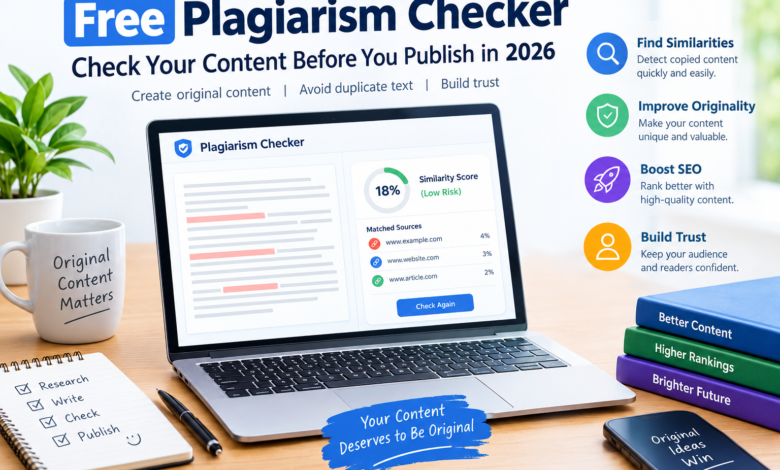
A free plagiarism checker is an online tool that scans written material for possible similarities.
Usually, you paste an article into a text box. Some services also allow document uploads. Afterward, the system analyzes the submitted material against the sources available to it.
The exact process differs from one service to another.
Some tools focus mainly on public websites. Others may provide access to larger collections of publications or other documents.
A report can contain several types of information, including:
- Similarity percentages
- Highlighted phrases
- Matching passages
- Possible source pages
- Links to matching material
- Sections that require review
Furthermore, different services can produce different results for the same article.
That does not necessarily mean one report is wrong.
Each system may use different databases and detection methods.
Why a Similarity Score Needs Context
Many plagiarism tools display a percentage.
For instance, a report might show 5%, 15%, or 25% similarity.
That number alone does not explain the entire situation.
Imagine an article about website development. Technical terms such as HTML, CSS, browser, server, and database can naturally appear on many pages. A match involving those terms does not automatically indicate copied content.
Similarly, a company name or product name may appear several times in different articles.
Therefore, the highlighted text deserves more attention than the headline percentage.
Read each match carefully.
Check the source when it is available.
Then decide whether the wording actually needs to change.
Similarity Is Different From Plagiarism
This distinction is essential.
A plagiarism system detects similarities between texts. It does not automatically determine the writer’s intention or the complete context.
For example, two writers can independently describe the same common fact. Their sentences may look somewhat similar. That does not automatically mean that one writer copied the other.
On the other hand, copying a complete paragraph from another website and presenting it as your own is a very different situation.
Research into plagiarism-detection systems also shows why automated similarity reports should be treated as support tools rather than perfect judgments.
As a result, human review remains important.
What Questions Should You Ask After a Scan?
Instead of asking only, “What is my percentage?” consider several other questions.
Which sentences were highlighted?
Why did they match?
Is the phrase commonly used?
Did I follow another source’s sentence structure?
Does this section require attribution?
Would a fresh explanation improve the paragraph?
These questions lead to better editing decisions.
Moreover, they prevent writers from making unnecessary changes just to reduce a number.
A Modern 2026 Workflow for Original Content
A strong content process involves more than running one plagiarism scan.
Start with research.
Then build an original outline.
Write the article.
Afterward, check facts and improve readability.
Next, run a plagiarism scan.
Finally, review the results before publication.
This workflow works for blogs, business websites, student assignments, and freelance projects.
Begin With More Than One Source
Depending on one article can influence your writing style.
You may unintentionally copy its structure or wording.
Instead, research several reliable sources.
Compare their information.
Look for missing details.
Notice where sources disagree.
Then create your own explanation.
As a result, the final article can have a broader perspective.
Build a Fresh Heading Structure
Avoid copying another website’s exact sequence of headings.
Your article should have its own organization.
For example, instead of using only generic headings such as “Benefits” or “Features,” create headings that address real reader questions.
Useful modern headings might include:
What Should You Review Before Uploading a Document?
Why Can Original Articles Still Show Similarity?
How Should Website Owners Check Content in 2026?
What Should You Do After Finding a Text Match?
These headings make the article more specific.
They also help readers understand what each section will cover.
Write From Understanding
Research the subject carefully.
Afterward, put the source material aside.
Explain the idea using your own understanding.
This approach naturally changes the wording and sentence structure.
In addition, it makes your writing sound less mechanical.
You can also add examples that fit your audience.
That extra context can make the article more useful.
How a Free Plagiarism Checker Supports SEO
SEO is not simply about inserting a keyword repeatedly.
Google’s current guidance focuses on helpful, people-first content. Pages should provide meaningful information instead of being created mainly to manipulate search rankings.
Therefore, plagiarism checking should be viewed as one part of content quality control.
It can help identify copied wording.
However, it does not measure the complete SEO quality of a page.
An effective article also needs a clear purpose, useful information, logical headings, good readability, and accurate facts.
Match the Article to Search Intent
Someone searching for free plagiarism checker may have several questions.
They might want to know how these tools work.
Perhaps they need to check an assignment.
Another user may want to review a blog article.
A website owner could be concerned about duplicate wording.
A useful article should address these different needs.
Instead of repeating the target keyword, explain the subject from several practical angles.
For example, discuss:
- How plagiarism checking works
- What similarity percentages mean
- How to interpret matches
- How to rewrite problematic sections
- What free tools may not detect
- Why privacy matters
- How plagiarism checking fits into SEO
This creates broader topical coverage.
Use Related Terms Naturally
A strong article does not need to repeat the same phrase in every paragraph.
Instead, use related language when appropriate.
Useful terms include:
- plagiarism detection
- similarity report
- duplicate text
- content originality
- copied wording
- online plagiarism tool
- originality check
- text comparison
- content review
As a result, the article remains natural while still covering the topic comprehensively.
How to Use a Free Plagiarism Checker Correctly
Using the tool is usually simple.
Interpreting the report requires more care.
Step 1: Complete the Draft
First, finish the article.
Do not interrupt your writing after every paragraph to run a scan.
A complete draft gives you a better document to review.
Step 2: Edit Before Scanning
Next, fix spelling and grammar problems.
Remove unnecessary repetition.
Improve awkward sentences.
Cut sections that do not contribute to the topic.
Consequently, the plagiarism report becomes easier to evaluate.
Step 3: Add the Article to the Tool
Paste your content into the checker.
If file uploads are available, you may be able to submit a document instead.
Free services can have different word limits, so check the current rules before starting.
Step 4: Run the Scan
Start the plagiarism check.
The tool will compare the content according to its available database and detection method.
Some services search public web content, while others offer broader source coverage.
Step 5: Review the Matches
Now examine the highlighted sections.
Do not assume that every match is a problem.
Look at the surrounding text.
Check the source.
Then decide whether the wording is genuinely too close.
Step 6: Rewrite When Necessary
If a passage closely follows another source, create a fresh explanation.
Change the structure.
Reorganize the information.
Use your own examples.
If the information belongs to another source, provide appropriate attribution.
Step 7: Check the Revised Version
Finally, run another scan after substantial changes.
This second review can help identify remaining similarities.
Why Simply Replacing Words Does Not Work
Some writers try to reduce similarity by changing individual words.
That is not a strong approach.
Suppose a source uses a sentence with ten words.
Changing two or three words still leaves most of the structure intact.
The result may sound unnatural.
It may also remain too close to the original.
Google’s spam guidance warns against creating low-value content by making minor changes to existing material, including automated synonym replacement.
Instead, understand the original idea.
Then write it again from scratch.
That produces a much more natural result.
How to Rewrite a Similar Passage
Start by reading the original passage carefully.
Identify its main idea.
Then stop looking at the original wording.
Ask yourself what the reader actually needs to know.
Explain that point in a fresh way.
You can change the sentence order.
You can combine two ideas.
You can remove unnecessary information.
You can also add an example.
As a result, the final paragraph becomes more independent.
Using a Free Plagiarism Checker for Blog Content
Bloggers can make plagiarism checking part of their normal editorial process.
Before publishing an article, review several areas.
Originality
Look for wording that is unusually similar to another source.
Accuracy
Verify important claims and numbers.
Readability
Make sure sentences are easy to follow.
Search Intent
Check whether the article actually answers the user’s question.
Added Value
Ask whether the page provides something useful beyond what existing articles already offer.
That last point matters.
Google’s people-first guidance encourages creators to consider whether their content provides substantial value compared with other pages.
Checking Content on a New Website
New websites often need a large amount of content.
However, speed should not replace quality.
Publishing many pages that simply repeat existing information does not automatically create a strong website.
Google’s spam policies address scaled content abuse when large amounts of content are produced mainly to manipulate search rankings instead of helping users.
Therefore, each article should have a clear purpose.
Give readers a reason to visit the page.
Provide information that solves a real problem.
Use original explanations.
A plagiarism check can then become one part of the final quality review.
What a Free Plagiarism Checker Cannot Guarantee
No checker can compare your article with every piece of writing that exists.
A tool may not have access to:
- Private documents
- Restricted academic databases
- Paywalled publications
- Unindexed pages
- Very recent pages
- Offline books
- Private student submissions
For that reason, a clean report should not be interpreted as absolute proof of universal originality.
It means the system did not identify a relevant match within the sources it could check.
That distinction is important.
Is 0% Similarity Always the Goal?
Not necessarily.
A 0% result may look ideal.
Still, some legitimate writing naturally contains common phrases.
Technical content can also contain standard terminology.
Proper quotations may produce matches as well.
Therefore, the quality of the matches matters more than chasing a specific number.
A useful article with a small amount of legitimate similarity can be better than an awkward article rewritten only to achieve zero.
Can Original Articles Still Show Similarity?
Yes.
Two writers can independently use similar language.
This often happens with:
- Definitions
- Technical terms
- Product names
- Company names
- Dates
- Common instructions
- Widely known facts
For example, an article about a specific software product will probably use the product’s official name several times.
That is not evidence of copying by itself.
Context matters.
Free Plagiarism Checker for Students
Students can use plagiarism tools before submitting assignments.
Research papers often contain information from several sources.
The challenge is to explain that material properly while giving credit where required.
A plagiarism scan can help identify sections that deserve another review.
However, university systems may use databases that public tools cannot access.
Therefore, students should follow their institution’s rules.
A free online checker can provide an additional review.
It should not replace official academic procedures.
Free Plagiarism Checker for Freelancers
Freelancers often work on multiple projects at once.
Different clients may have different originality requirements.
Researching competing articles can sometimes lead to accidental similarities.
A final scan provides an additional quality-control step.
Before delivering the work, the writer can review the report and correct suspicious sections.
This process can reduce avoidable problems.
It also creates a more professional editing routine.
Free Plagiarism Checker for Businesses
Businesses publish many types of content.
Their websites may contain product pages, blog posts, guides, landing pages, and support material.
Repeated information can appear across these pages.
Sometimes that repetition is necessary.
At other times, it can be reduced.
A plagiarism or similarity check can help identify repeated wording that deserves review.
The business can then decide whether the wording should remain, change, or move to another page.
Privacy Matters When Uploading Content
Convenience should not be the only consideration.
Some documents contain sensitive information.
Examples include:
- Client projects
- Unpublished research
- Internal reports
- Business plans
- Personal documents
- Private manuscripts
Before uploading such material, read the service’s privacy policy.
Find out whether text is stored.
Check whether submissions are used for future comparisons.
Understand the provider’s deletion practices.
As a result, you can choose a service that fits the sensitivity of your content.
A Better 2026 Content Quality Checklist
Before publishing an article, review it from several angles.
Content
Does the article answer a real question?
Does every section have a purpose?
Have you removed unnecessary filler?
Originality
Did you write the explanation yourself?
Did you avoid copying another site’s structure?
Did you review the plagiarism report?
Sources
Did you keep track of important sources?
Did you cite material where necessary?
Did you verify important claims?
SEO
Is the main keyword used naturally?
Are related terms included where they make sense?
Does the title match the search intent?
Are the headings clear?
Readability
Are sentences easy to understand?
Do paragraph openings vary?
Have you used transition words naturally?
Does each section connect smoothly with the next?
This final point is useful for readability as well as human readers.
Words such as however, therefore, meanwhile, additionally, for example, in contrast, as a result, instead, similarly, finally, and consequently can help connect ideas when they genuinely fit the meaning.
Do not add them randomly.
A transition should clarify the relationship between two ideas.
The Real Goal Is Useful Original Content
A plagiarism percentage is only one measurement.
It cannot tell you whether your article is helpful.
It cannot determine whether your examples are good.
It cannot verify every factual statement.
It cannot understand your audience completely.
Those responsibilities remain with the writer.
Therefore, use the checker as part of a larger process.
Research properly.
Write naturally.
Edit carefully.
Fact-check important information.
Review similarity results.
Then make thoughtful changes.
Final Thoughts
A free plagiarism checker can be a useful tool for modern content creation.
Students can use one before submitting assignments. Bloggers can review articles before publishing them. Freelancers can check client projects. Businesses can add plagiarism checking to their editorial workflow.
However, the tool should never be treated as the entire originality process.
A similarity percentage is only a signal.
The highlighted passages provide more useful information.
Read them carefully.
Check the sources.
Understand why they match.
If the wording is too close, rewrite the idea naturally.
Do not rely on simple synonym replacement.
Do not copy another website’s heading structure.
Do not create an article simply by changing a few words.
Instead, research the topic from multiple sources and build your own explanation.
In 2026, useful content needs more than surface-level rewriting. Google’s current guidance continues to emphasize content made for people, original information, and meaningful value.
That is why originality should be treated as part of the complete publishing process.
A free plagiarism checker can help you find possible problems.
Your judgment fixes them.
Your research gives the article substance.
Your writing gives it a unique voice.
And your final review makes sure the content is ready for real readers.
read more: https://dailyblogwriter.com/